VATSIM Operations
Background
VATSIM strives to replicate the real world aviation environment as closely as possible. However, the network is a place of learning for both controllers and pilots, and it is unreasonable to expect a 1:1 service.
Pilots should reference real world documents and charts but be prepared for some inconsistencies and discrepancies to exist. The procedures detailed on this site (particularly the Local Procedures) have been designed to compliment VATPAC's ATC SOPs.
VATSIM Code of Conduct
A number of policies govern how users of the VATSIM network must conduct themselves. Pilots should be aware of the Code of Conduct, which outlines the minimum pilot competency level, connection requirements, and other important information.
Warning
Failure to comply with the Code of Conduct will result in network supervisors taking action against your account, which may include suspension or deletion.
Restricted Activities
As per the VATSIM Special Operations Policy, the following activities are restricted on the VATSIM network. They may only be performed by pilots who are a member of, and flying an operation representing, an approved Virtual Special Operations Association.
- Conducting joint training exercises with other approved VSOAs
- War games
- Air to air refuelling
- Carrier operations
- Flying low level military routes
- Flying escort missions
- Executing air combat manoeuvres
- Interception/scramble of other aircraft
- Having access to special use airspace
- Search and Rescue Operations
- Firefighting Operations
- Launch and Recovery of Space Vehicles
- Air Displays (Flying Displays, Races)
- Fly unmanned aerial vehicles, e.g. Global Hawk
Radio Communication
As per the VATSIM Code of Conduct, pilots operating OCTA (or without any ATC online) must monitor the appropriate advisory frequency and make radio broadcasts as deemed necessary. In the enroute phase of flight (and outside the vicinity of an aerodrome), pilots should monitor the advisory frequency.
The VATSIM advisory frequency is 122.800.
Pilots operating in the vicinity of an uncontrolled aerodrome must monitor, and broadcast on, the appropriate CTAF.
Voice is the preferred method of communication on VATSIM. Account holders should use voice if able to do so but must accommodate the use of text to support those with a disability who are unable to utilise voice. Only unaltered speech is permitted to be transmitted. Pilots shall be able to, at a minimum, receive voice but may send messages via text (Receive Only).
Pilots should be aware of the existence of both voice-capable and text-only pilots, and consider making broadcasts via both voice and text where appropriate.
Some pilots may not be using real-world weather or time of day, so pilots should be alert to aircraft using reciprocal or crossing runways, or flying different approaches, at uncontrolled aerodromes.
CTAFs
Pilots operating in the vicinity of an uncontrolled aerodrome must monitor, and broadcast on, the relevant CTAF. Generally speaking, the CTAF on VATSIM matches the CTAF in the real world. However, at some locations, a dedicated CTAF has been published for use on VATSIM.
The CTAF for each aerodrome can be found by referencing its appropriate ERSA entry or reviewing its aerodrome chart. These resources are available on the Airservices website for free or through providers like Navigraph, Chartfox and the VATPAC Tools page.
Additionally, the VATSIM AIP includes all VATPAC aerodromes, with information including the correct frequency to use. This is particularly important for locations like Sydney, Melbourne, and the other Class C airports which operate 24 hours a day in the real world. VATPAC has defined an appropriate CTAF for these locations which should be used by pilots when there is no ATC coverage online.
Tip
Pilots can type .ctaf into any VATSIM pilot client to display the appropriate frequency to use at an aerodrome.
On VATSIM, some aerodromes may be partially controlled and may, or may not, require CTAF calls to be made.
Top Down Rule
VATSIM employs a 'top down' rule, whereby controllers may (and in some cases, are expected to) provide a level of coverage to terminal areas and controlled aerodromes within their jurisdiction. This provides a greater service level to pilots but may cause some minor confusion for new members.
Tools like VATSIM Radar and the VATPAC Map display all online controllers. Any major controlled aerodromes which fit inside these sectors can be assumed to have top down coverage, with the overlying controller performing the roles of ADC and SMC/ACD if applicable.
Example
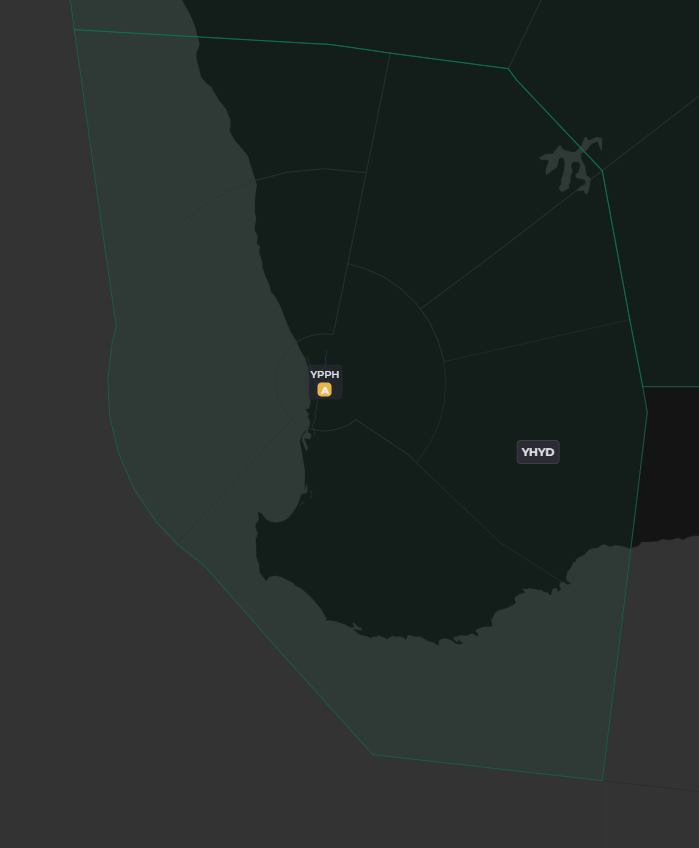
The controller above is logged on as HYD (Melbourne Centre enroute position) which overlays the Perth terminal area and YPPH. Aircraft on the ground at YPPH should contact HYD for airways clearance and all subsequent calls.
Pilots should contact the lowest applicable controller as they move up from the aerodrome level to enroute.
Example
GUN and Sydney ADC are both online. A pilot on the ground at YSSY wishing to obtain airways clearance would contact SY ADC, as they are the lowest controller over Sydney.
Zulu ATISes
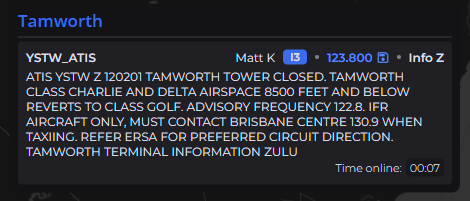
A Zulu ATIS (ATIS with code Z) may be published by controllers to indicate that an aerodrome which can be temporarily activated is currently uncontrolled. Pilots of IFR aircraft should contact the overlying controller prior to taxi to commence their SARWATCH service. Pilots should refer to Local Procedures to determine whether any special procedures apply to the aerodrome, but may otherwise taxi and depart at their own discretion.
Enroute Sector Extensions
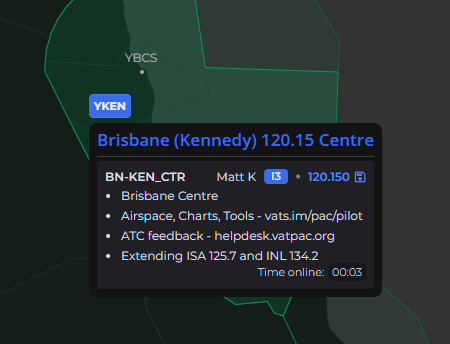
Enroute controllers have the option of extending from their primary log on position to other adjacent sectors. When this is the case, they will use an appropriate means to notify surrounding controllers and pilots.
Each controller has a short remark, called a Controller ATIS, associated with their session. The majority of controllers will publish their sector extensions in their Controller ATIS. Mapping tools like VATSIM Radar and the VATPAC Map will automatically display these extended sectors. Top Down rules apply to any major, controlled aerodromes contained inside an extended sector.
Important
Some older mapping tools do not display extended sectors correctly (or at all). Pilots are strongly encouraged to use VATSIM Radar or the VATPAC Map to ensure they have the most up-to-date information at hand, and can comply with their obligations under the VATSIM Code of Conduct at all times.
The sector extension principle is unique to only a handful of divisions worldwide and can be a source of confusion for new or foreign pilots. Expect to be instructed to contact a controller on a frequency which isn't displayed in your pilot client. The use of mapping tools as discussed above can help alleviate this confusion by providing a visual indication of the extent of a controller's jurisdiction.