Melbourne (YMML)
Taxiing
Standard Taxi Routes
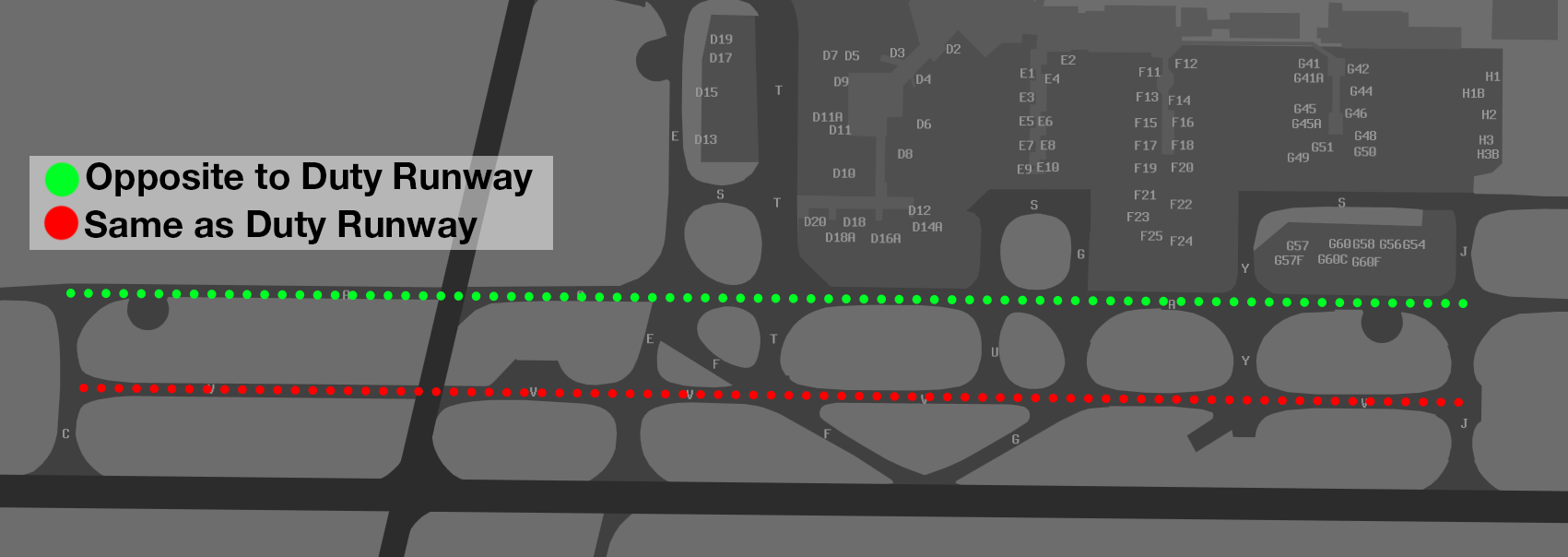
Standard taxi routes exist to simplify issued taxi instructions. Unless explicit instructions are received, the following taxiways should be used in the directions indicated below:
| Taxiway | Direction of Travel |
|---|---|
| Alpha | Opposite to Duty Runway |
| Victor | Same Direction as Duty Runway |
Example
With runway 34 in use, taxiway Alpha would be used for aircraft taxiing southbound and taxiway Victor would be used for aircraft taxiing northbound.
Important
SMC may issue instructions that differ from these standard taxi routes. Always comply with SMC's instructions.
Scenery Limitations
The taxiway layout at YMML has changed over the years, with taxiway E being relocated to accommodate the new taxiway D. Due to the work-in-progress status of the construction, VATPAC controllers will continue to utilise taxiway E in it's original position. If your scenery has updated to include taxiway D, you must inform ML SMC when requesting taxi to runway 27 or when operating to/from aprons 1, 2, or 3.
Phraseology
QJE1501: "Melbourne Ground, QJE1501, received F, request taxi, we can accept taxiway D"
Additionally, the apron at terminal 4 has been adjusted to include APN8 and APN9, two new taxilanes capable of simultaneous pushbacks from pier F and G. Ensure you remain situationally aware of other aircraft on the apron and inform SMC if you are unable to remain clear of an aircraft operating nearby.
Departures
VFR aircraft should expect to depart via a visual departure, on track to their first tracking point.
IFR aircraft should expect to be issued with a SID as per below:
| Aircraft Type | Runway | First Waypoint | SID |
|---|---|---|---|
| Jets | All | CORRS | CORRS SID |
| Jets | All | CRENA | CRENA SID |
| Jets | All | DOSEL | DOSEL SID |
| Jets | All | ESDIG | ESDIG SID |
| Jets | All | KEPPA | KEPPA SID |
| Jets | All | MNG | MNG SID |
| Jets | All | NONIX | NONIX SID |
| Jets | All | PEDNI | PEDNI SID |
| Jets | All | SUNTI | SUNTI SID |
All other aircraft shall expect the ML (RADAR) SID.
Note
With RWY 27 nominated as the duty departure runway, aircraft requiring the use of RWY 16 for the west or north should expect to be issued with the ISPEG SID.
Pushback/Taxi on ACD
During periods of high traffic, pilots may be required contact ACD for pushback. ACD will assess aerodrome congestion and sequence departing aircraft before transferring them to SMC. Delays should be expected.
When the ATIS includes ALL DEPARTURES MUST REQUEST PUSH BACK ON 127.2, all pilots must contact ACD when ready for pushback or taxi (if no pushback is required).
Phraseology
JST14: "JST14, bay 32, request pushback"
ML ACD: "JST14, standby, estimated delay 10 minutes"
When instructed, pilots must switch to SMC and monitor the frequency. Do not contact SMC, they will call you.
Phraseology
ML ACD: "JST14, standby for ground, 121.7"
JST14: "Standby for ground, 121.7, JST14"
Pilot switches to 121.7 and waits for the controller to contact them.
ML SMC: "JST14, Melbourne Ground, pushback approved"
JST14: "Pushback approved, JST14"
There may be a delay on the SMC frequency before the controller contacts you. Pilots should only initiate contact with SMC if a significant amount of time has passed since the frequency transfer and no contact has been made by the controller. During busy periods with high frequency congestion, delays may be lengthy.
Pushback Disconnect Points
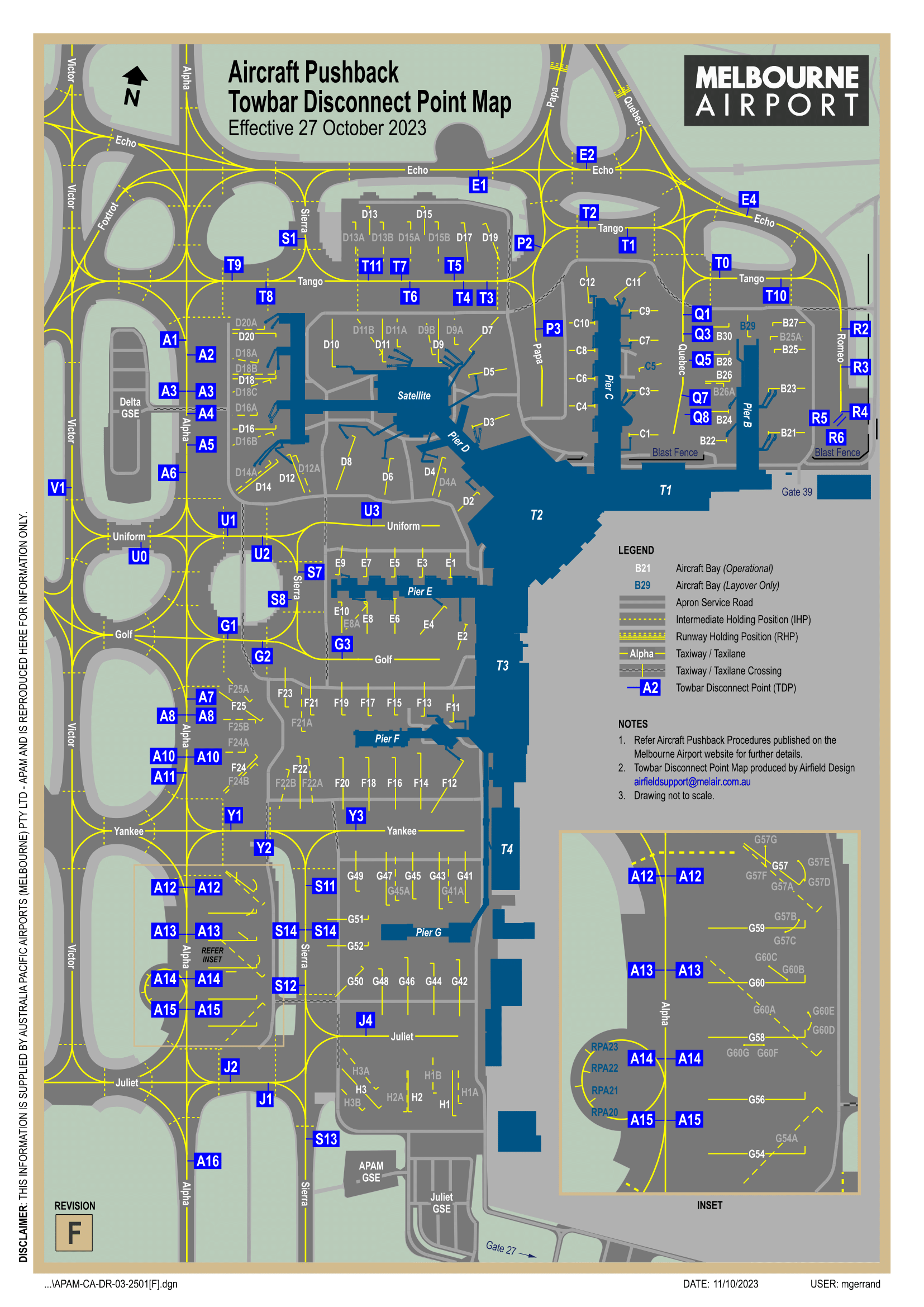
Towbar disconnect points (TDPs) are positions on the aprons and taxiways where a tug may disconnect from an aircraft, completing the pushback. Every bay has a standard TDP, however a different TDP is occassionally assigned by SMC to expedite ground traffic flow.
Important
Third-party simulator plugins may be necessary to customise your pushback and utilise a published disconnect point. For that reason, they are not used by default. However, ATC may ask whether you are capable of towing to a disconnect point and provide the instruction where it would benefit the flow of traffic.
Phraseology
QFA728: "Melbourne Ground, QFA728, received November, bay Charlie 11, request pushback"
ML SMC: "QFA728, pushback approved, disconnect point Tango 10"
QFA728: "Pushback approved, disconnect point Tango 10, QFA728"
Arrivals
An ILS is available for RWY 16 and RWY 27. RNP and GLS approaches are available for all runways. RNP(AR) approaches are available for RWY 16. VOR approaches are available for RWY 09, RWY 27 and RWY 34.
IFR aircraft can generally expect to be processed via a STAR terminating with the following approach:
| Runway | Approach |
|---|---|
| 09 | RNP |
| 16 | ILS |
| 27 | ILS |
| 34 | RNP |
With RWY 34 in use, aircraft from the northeast may be cleared via the Victor STAR for a visual approach. Refer to the relevant chart and be aware of the tight turn from base to final. Careful planning and speed control is necessary to avoid overshooting final.
Preferred Runway Exits
The AIRPORT EFFICIENCY PROCEDURES chart dictates preferred runway exits for pilots to vacate at. This ensures a predictable, efficient movement of aircraft on the aerodrome and should be abided by where possible. Where a preferred exit is not assured, pilots must inform ADC.
| Runway | Aircraft Type | Preferred Exits |
|---|---|---|
| RWY 09 | Turboprop Other |
A P, otherwise Q |
| RWY 16 | All | G, otherwise E or J |
| RWY 27 | All Heavy |
N M |
| RWY 34 | All | F, otherwise E or C |
Rerouting
Some aircraft from the northeast or south may be rerouted for traffic management. Pilots should be aware of the following waypoints and expect possible tracking as per the table below.
| Inbound Direction | Amended STAR/Procedure | Possible Routing |
|---|---|---|
| Northeast | RWY 16 RNP-M | DCT LUVKA |
| Northeast | BOYSE STAR | DCT BOYSE, or DCT WAZZA BOYSE |
| Northeast | BOOIN STAR | DCT BOOIN, or DCT BULLA BOOIN |
| South | PORTS STAR | Via cleared route, or DCT ONAGI |
Predictable Sequencing Waypoints
ATC may utilise predictable sequencing waypoints to tactically delay aircraft inbound via Q29, Q346, Q35, H215, P753, L508, and M625. Pilots should be aware of the following waypoints and expect possible tracking as per the table below.
| Initial Waypoint | New Waypoint | Final Waypoint | Delay (in mins) |
|---|---|---|---|
| ANLID | DOVEX | BULLA | 2 |
| ANLID | TOPUL | BULLA | 4 |
| ANLID | UNSIG | BULLA | 6 |
| ANLID | NILEV | BULLA | 8 |
| Initial Waypoint | New Waypoint | Final Waypoint | Delay (in mins) |
|---|---|---|---|
| UPNAP | IGPEB | DORSU | 1 |
| UPNAP | ONOPO | DORSU | 3 |
| UPNAP | URGUL | DORSU | 5 |
| UPNAP | IBOVU | DORSU | 7 |
| Initial Waypoint | New Waypoint | Final Waypoint | Delay (in mins) |
|---|---|---|---|
| IGMIL | IGPEB | DORSU | 2 |
| IGMIL | ONOPO | DORSU | 4 |
| IGMIL | URGUL | DORSU | 6 |
| IGMIL | IBOVU | DORSU | 8 |
| Initial Waypoint | New Waypoint | Final Waypoint | Delay (in mins) |
|---|---|---|---|
| ELNIV | OTGUN | RAZZI | 2 |
| ELNIV | OSEMI | RAZZI | 4 |
| ELNIV | UGITO | RAZZI | 6 |
| ELNIV | SEBLU | RAZZI | 8 |
| Initial Waypoint | New Waypoint | Final Waypoint | Delay (in mins) |
|---|---|---|---|
| AKTAM | SEBLU | RAZZI | 2 |
| AKTAM | UGITO | RAZZI | 4 |
| AKTAM | OSEMI | RAZZI | 6 |
| AKTAM | OTGUN | RAZZI | 8 |
LAHSO
LAHSO is the independent operation of two crossing runways for arrivals and departures. It is a complicated procedure which is rarely used, but occassionally run during VATPAC's busiest events featuring YMML. Strict pilot requirements apply during LAHSO.
The active aircraft is the landing aircraft issued with a hold short instruction, prohibiting them from rolling out on their assigned runway beyond the intersection with the crossing runway.
The passive aircraft is the landing or departing aircraft which has full use of their assigned runway.
YMML operates LAHSO using RWY 27 as the passive runway and RWY 34 as the active runway.
Pilot Requirements
All Australian registered aircraft operating under a flight number callsign are assumed to be approved active participants. If a pilot is unable to participate, ATC must be informed no later than 120nm from the destination aerodrome.
Phraseology
VOZ852: "VOZ852, negative active LAHSO"
BLA: "VOZ852"
Other pilots who wish to participate must notify ATC no later than 200nm from the destination aerodrome.
Phraseology
ANZ1984: "Melbourne Centre, ANZ1984, maintaining F360, LAHSO approved"
BLA: "ANZ1984, Melbourne Centre"
Pilots who are unable to participate actively will be sequenced as a passive aircraft. Pilots who are unable to participate at all will be sequenced for an independent approach.
Scenic Flights
Melbourne Coastal Route
A designated VFR route is established on the shores of Port Phillip Bay. This route is flown below the base of controlled airspace and an airways clearance is not required. Details of the route can be found on the Melbourne VTC. Pilots should make appropriate broadcasts on the advisory frequency, so as to remain clear of other aircraft operating on the route.
Tip
The Melbourne VTC can be found on the AIP Website.
Recommended altitudes have been established to segregate opposite direction traffic, as per below:
| Route Segment | Direction of Travel | Recommended Altitude |
|---|---|---|
| Laverton BOM Tower to Point Ormond | Eastbound | A015 |
| Westbound | A020 | |
| Port Ormond to Carrum | Southbound | A015 |
| Northbound | A025 |
Keep to the right side of the lane to avoid oncoming traffic and ensure you avoid the Moorabbin CTR.
Melbourne City Orbits
Visual orbits of the CBD are managed by Essendon ADC, or Melbourne TCU when the Tower is closed.