Nadi (NFFN)
Airspace
NFFN ADC is responsible for the Class D airspace from SFC to A025 within a 10nm radius.
Taxiing
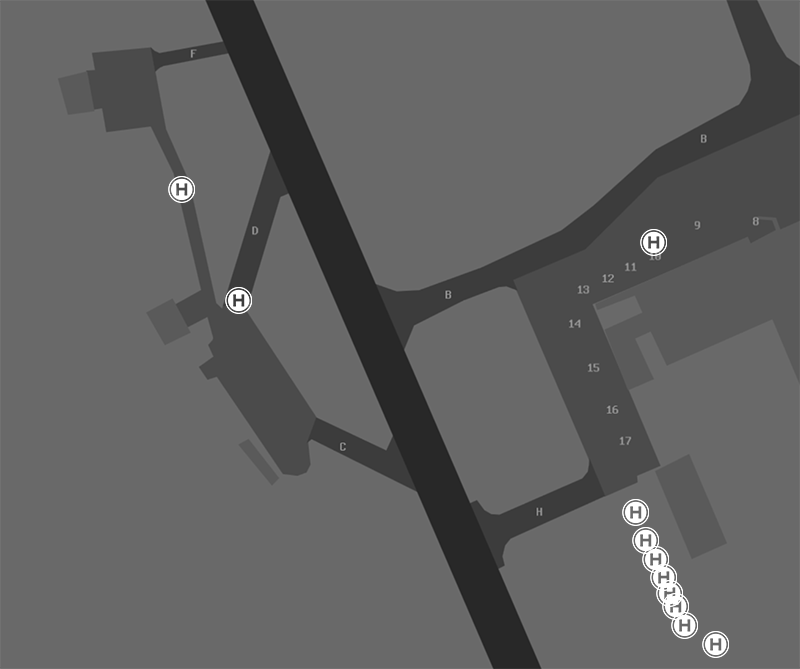
NFFN ADC is responsible for Taxiway C, D, and F, as well as the grass area east of H.
Taxiway B south of Taxiway G is restricted to Code C aircraft. Taxiway H is restricted to aircraft no larger than AT72.
Departures
Due to terrain, the preferred runway for departures is RWY 20. Most international aircraft will require RWY 02/20 in most conditions, although medium category aircraft and below may be assigned RWY 27.
Departure Procedures
VFR aircraft should plan via a departure gate.
IFR aircraft planned via TUTRI, KABAR, BIDNA, LATIT, PACKO, MAKSO, GODAP, LUPLO, EXORA,NA, NAVUA, AGTOS, BEACH, ALBAB, TEPEK, VIPOB shall expect to be issued a procedural SID. All other aircraft shall expect a visual departure or radar SID.
Arrivals
The preferred runway for arrivals is RWY 02. Medium category aircraft and below may be assigned RWY 09/27.
Arrival Procedures
An ILS and NDB approach is available to RWY 02. An RNP approach is available to RWY 02 and 09. An RNP(AR) approach is available to RWY 20. A VOR approach is available to the circling area.
VFR aircraft should plan via an arrival gate.
Night Operational Restrictions
Due to the surrounding mountainous terrain, the following restrictions are applied at night:
- RWY 20 is only available to aircraft flying the RNP AR approach. Visual approaches are not permitted.
- RWY 09 is not available for departures.
- RWY 27 is not available for arrivals.
Helicopter Operations
VFR helicopters should plan via a VFR transit lane. IFR helicopters should conform to fixed wing operations and expect a radar departure, or visual departure if conditions allow.
All helipads at NFFN are uncontrolled. Pilots will not receive an explicit takeoff or landing clearance. Instead, they will be instructed to 'report airborne' or 'report on the ground'.
VFR Operations
Departure/Arrival Gates
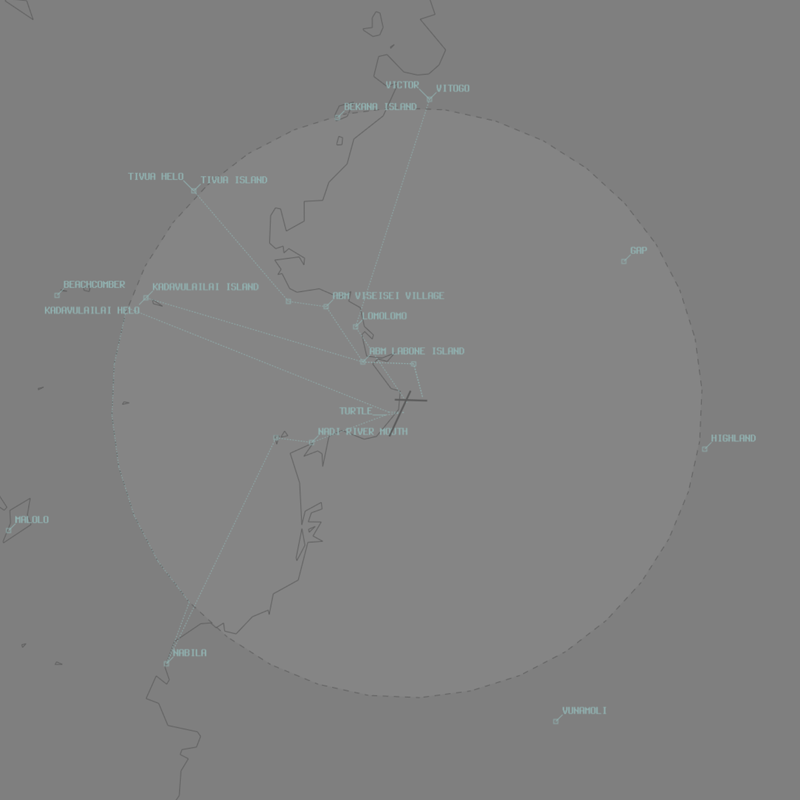
Aircraft should report at the standard VFR Departure/Arrival Gates.
| Direction from NFFN | Name | Dep/Arr |
|---|---|---|
| North | Vitogo | Both |
| North | Bekana Island | Both |
| Northeast | Gap | Both |
| Northeast | Highland | Both |
| Southeast | Vunamoli | Both |
| Southwest | Nabila | Both |
| West | Kadavulailai Island | Both |
| West | Beachcomber | Both |
| Northwest | Tivua Island | Both |
VFR Transit lanes
VFR transit lanes are established to allow aircraft to transit through the NFFN CTR, by day.
| VFR Route Name | Description | Altitude |
|---|---|---|
| FJV1 Turtle | Seaplane Base-Abeam Kadavulailai Island, then along CTR boundary to Nabila-Yakuilau-Nadi River Mouth, then along coast back to Seaplane Base | SFC to A005 |
| FJV2 Victor | NFFN-Lololomo Beach-Vitogo | A050 to A015 |
| FJV4 Kadavulailai Helicopter Lane | Heliport-The Bridge-ABM Labone Island-Kadavulailai Island | SFC to A005 |
| FJV5 Tivua Helicopter Lane | Heliport-The Bridge-ABN Labone Island-ABM Viseisei Village-ABM Vuda Marina-Tivua Island | SFC to A005 |
Tiliva Training Area
The Tiliva Training Area is established north of the NFFN CTR, from A005 to A040, and is activated upon pilot request.
Aircraft transiting between the NFFN CTR and the training area should track inbound/outbound via Vitogo.