Holding
Background
Holds are flown where a delay of any kind is required. They can be initiated by ATC as part of sequencing actions inbound to a busy aerodrome, or by the pilot where a delayed arrival is beneficial (poor weather, aircraft malfunction, traffic, etc).
IFR
IFR aircraft should generally hold in a predictable, 'race track' pattern. Rate one turns (or 25° bank angle, if less) should be used at either end and the outbound leg timed to comply with the holding limitations relevant to the holding position and altitude. To become established in the holding pattern, one of three sector entries shall be flown.
Holding information is found on ERC and TAC charts for enroute and terminal holds. Additionally, most instrument approach procedures and some STARs include published holds. Where a published hold is not available or suitable, pilots may hold at any position (with ATC approval in CTA), using the most suitable inbound track, turn direction, and altitude.
Holding Limitations
Airspeed and outbound timing limitations exist to ensure aircraft remain within a designated proximity to the holding fix. This is important to ensure aircraft remain within the surveyed area applicable to the hold.
| Altitude | Max Outbound Leg Timing | Max Airspeed |
|---|---|---|
| Up to & including FL140 | 1 min | 230 KIAS (or 170 KIAS for Cat A & B procedures) |
| FL140 up to & including FL200 | 1.5 min | 240 KIAS |
| Above FL200 | 1.5 min | 265 KIAS |
Note
ATC may cancel the speed restrictions or approve longer outbound legs when operating in CTA.
In some holding patterns, a DME limit is defined. A turn to the inbound leg must be commenced no later than this DME distance.
Sector Entries
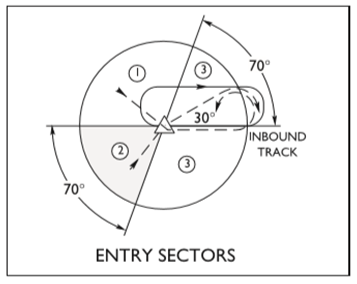
Designated sector entries allow aircraft to enter a hold without exceeding the limits of the surveyed area. Pilots should assess their current heading (not track) and choose the most appropriate sector entry. If the aircraft's heading is within 5° of two sector entries, either may be selected.
The capture regions for each sectory entry are shown in the image below.
Source: www.skybrary.aero
Sector 1 (Parallel)
From overhead the fix, turn to parallel the outbound track for the appropriate outbound leg time (or until reaching the DME limit), then turn towards, and intercept, the inbound leg.
Sector 2 (Teardrop)
From overhead the fix, turn to a track 30° offset from the outbound track for the appropriate outbound leg time (or until reaching the DME limit), then turn towards, and intercept, the inbound leg.
Sector 3 (Direct)
From overhead the fix, commence a turn to the outbound leg.
VFR
Published holding procedures rarely exist for VFR aircraft. If instructed to hold by ATS, pilots should manoeuvre in a suitable fashion and ensure they do not exceed their clearance limit. This will likely involve conducting orbits or 'race track' patterns.
Helicopters should consider holding in a similar manner, maintaining forward flight to minimise fuel burn. If instructed to hover, this must be complied with.