Sydney (YSSY)
Future Procedure
This page documents future procedures that are scheduled to be introduced on 09 July 2026.
Pilots are strongly encouraged to familiarise themselves with the incoming changes before launch day.
Taxiing
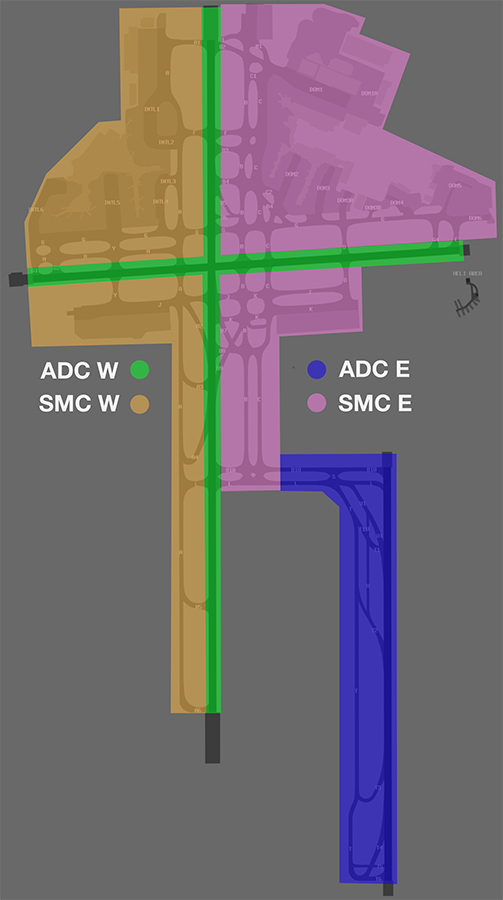
There are two SMC positions at Sydney. SMC West controls aprons and taxiways west of RWY 16R/34L, while SMC East controls east of RWY 34L/16R.
ADC East (when online) controls the taxiways surrounding RWY 16L/34R east of Taxiway C. See Runway 16L/34R for details.
Standard Taxi Routes
Standard Taxi Routes are utilised at Sydney to simplify taxi instructions and streamline traffic flow. Except where other explicit taxi instructions are issued, pilots should follow the routes described below.
Important
SMC may issue instructions that differ from these standard taxi routes. Always comply with SMC's instructions.
All runway crossings require a specific clearance, even if standard taxi routes are used.
General Flow
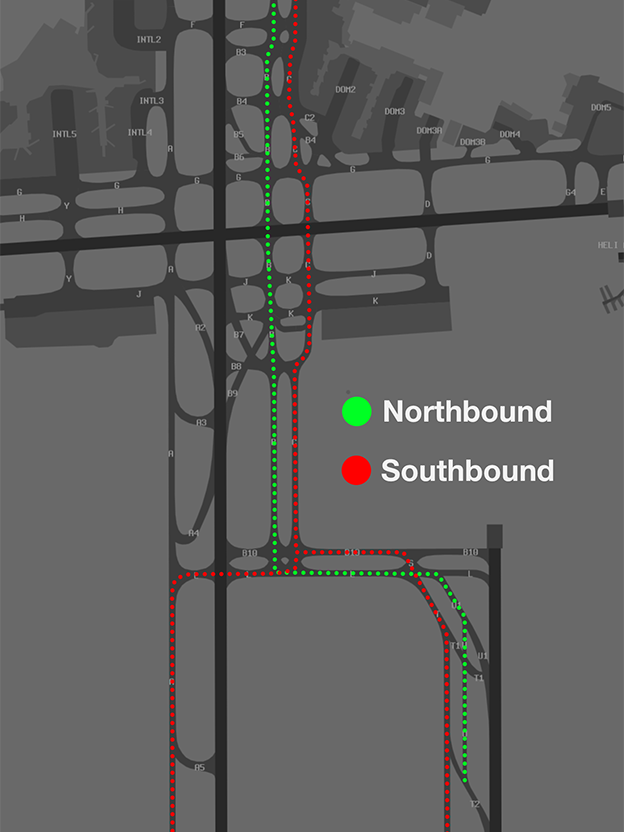
| Taxiway | Direction of Travel |
|---|---|
| B | Northbound |
| C | Southbound |
| B10 | Eastbound (except holding point for 34L) |
| L | Westbound |
Arrivals on RWY 16L/34R shall follow standard taxi routes when vacating the runway. These taxi routes should be performed without prompting by ADC.
| Landing Runway | Route |
|---|---|
| RWY 16L | T, L |
| RWY 34R | T2, U, U1, L, or U1, L |
Domestic Aprons
Additional standard taxi routes exist in and out of the domestic aprons.
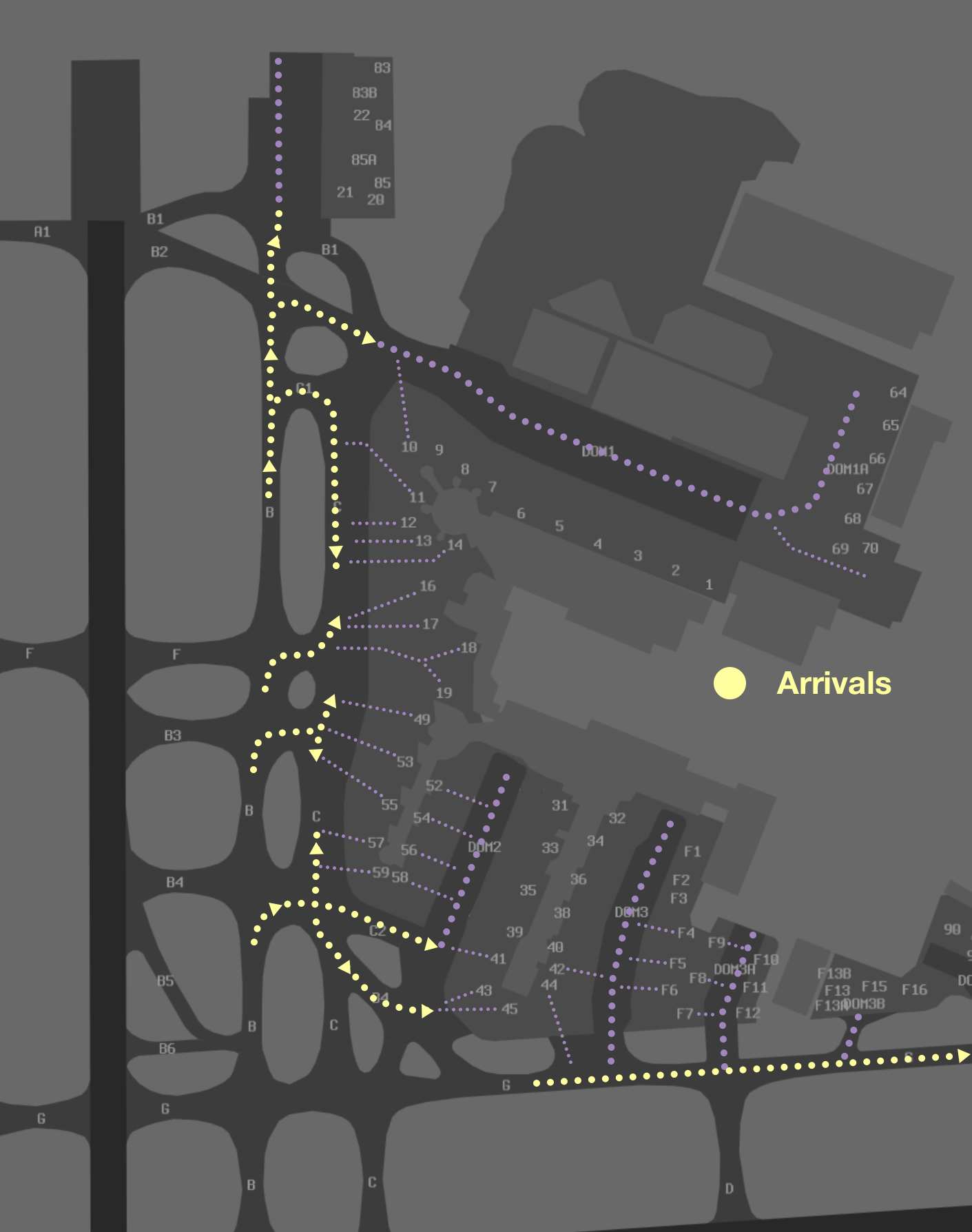
| Parking Position | Route |
|---|---|
| B1 Apron | B |
| DOM1 & DOM1A | B, B2 |
| Taxiway C (Bays 11-14) | B, C1 |
| Taxiway C (Bays 16-19) | B, F |
| Taxiway C (Bays 49, 53, 55) | B, B3 |
| Taxiway C (Bays 57, 59) | B, B4 |
| DOM2 (All bays except below) | B, B4, C2 |
| DOM2 (Bays 43, 45A) | B, B4 |
| DOM2 - A330 aircraft (Bays 39, 45) not pictured | B, G, DOM2 |
| DOM3, DOM3A, DOM3B, DOM4, DOM5 & DOM6 | B, G |
Example
If an aircraft vacates runway 34L for bay 52 and is instructed to 'cross runway 25, taxi to the bay', they would be expected to taxi via B, B4, and C2.
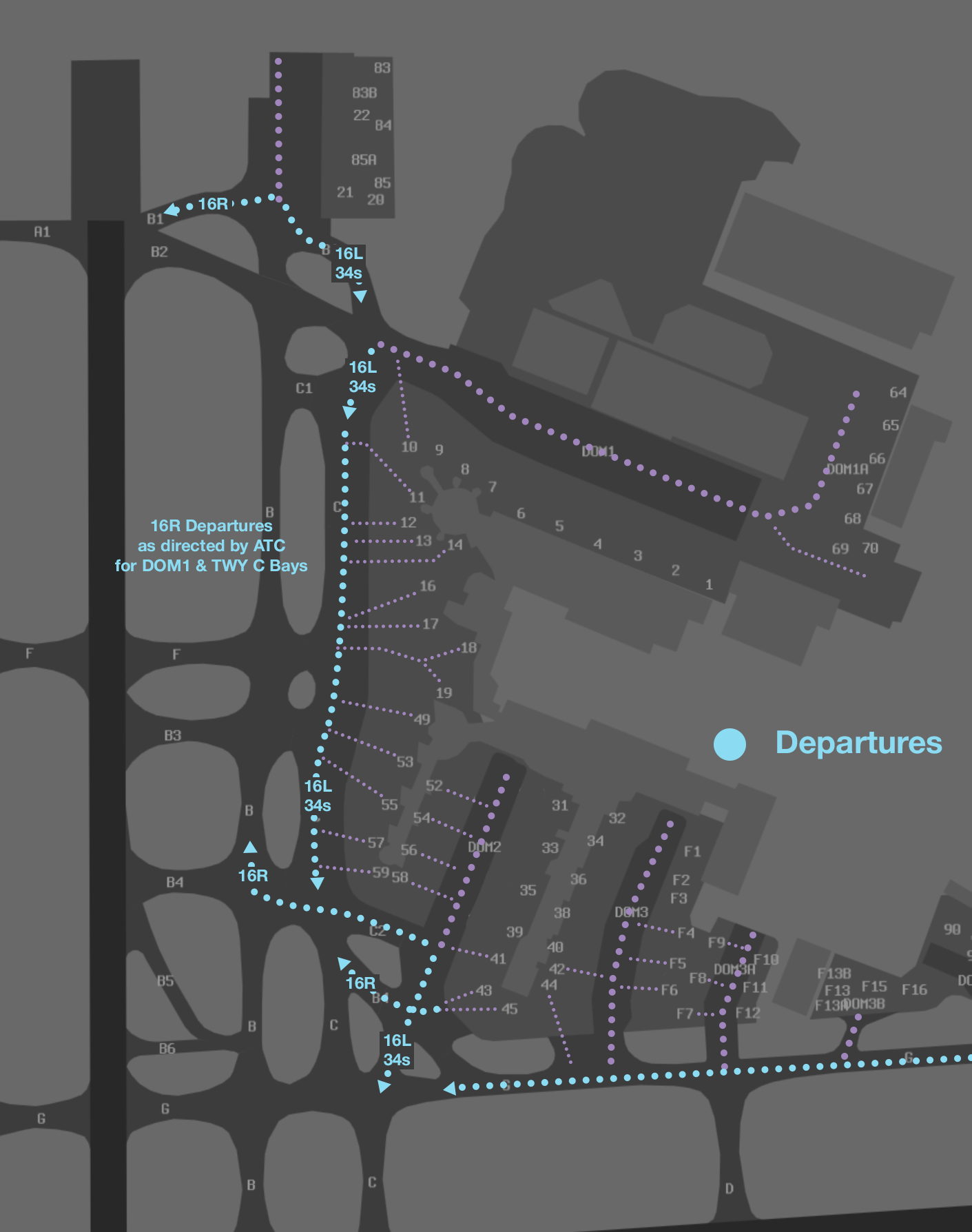
| Parking Position | Departure Runway | Route |
|---|---|---|
| B1 Apron | 16R 16L 34L - Prop 34L - Jet 34R |
B1 B1, C, B10 B1, C, B10 B1, C, L, A, A6 B1, C, B10, S, T, T6 |
| DOM1, DOM1A & Taxiway C Bays | 16R 16L 34L - Prop 34L - Jet 34R |
As Directed by ATC C, B10 C, B10 C, L, A, A6 C, B10, S, T, T6 |
| DOM2 (All bays except below) | 16R 16L 34L - Prop 34L - Jet 34R |
C2, B4 DOM2, C, B10 DOM2, C, B10 DOM2, C, L, A, A6 DOM2, C, B10, S, T, T6 |
| DOM2 (Bays 43, 45A) | 16R 16L 34L - Prop 34L - Jet 34R |
B4 DOM2, C, B10 DOM2, C, B10 DOM2, C, L, A, A6 DOM2, C, B10, S, T, T6 |
| DOM2 - A330 aircraft (Bays 39, 45) | 16R 16L 34L 34R |
DOM2, G, B DOM2, C, B10 DOM2, C, L, A, A6 DOM2, C, B10, S, T, T6 |
| DOM3, DOM3A, DOM3B, DOM4, DOM5 & DOM6 | 16R 16L 34L - Prop 34L - Jet 34R |
G G, C, B10 G, C, B10 G, C, L, A, A6 G, C, B10, S, T, T6 |
Example
If a jet aircraft from bay 6 for departure from runway 34L is instructed to 'cross runway 25, hold short runway 34L', they would be expected to taxi via C and L.
Runway 16L/34R Procedures
RWY 16L/34R is controlled by a separate ADC position (SY-E_TWR) which covers the duties of both SMC and ADC east of taxiway C and south of B10.
In line with Australian radiotelephony procedures, only international aircraft will receive an explicit transfer from SMC to ADC, and vice versa. When taxiing to RWY 16L/34R, domestic aircraft should contact ADC when on taxiway B10.
Standard taxi routes exist for aircraft to utilise after landing on RWY 16L/34R, which should be performed without prompting by ADC.
Inbound aircraft must remain on the tower frequency until west of taxiway S, then contact SMC on 121.7. International aircraft will receieve an explicit frequency transfer.
Important
When taxiing westbound on L, all aircraft must hold short of C and await onwards taxi instructions from SMC.
Departures
Departure Runway
During PROPS, pilots can expect to be assigned a departure runway in accordance with the table below.
| Aircraft tracking | Runway |
|---|---|
| via KADOM | 16R/34L |
| Jets via WOL | 16R/34R |
| Non-Jets via WOL | 16R/34L |
| via RIC | 16R/34L |
| via OLSEM | 16L/34R |
| Other aircraft: | |
| To the NORTH and EAST | 16L/34R |
| To the SOUTH and WEST | 16R/34L |
Jet departures to the south may be assigned RWY 16L/34L ad-hoc for traffic management purposes. ATC may nominate RWY 16L for all jet departures via WOL. This will be announced in the ATIS: "DOMESTIC JET DEPARTURES VIA WOL EXPECT RWY 16L".
Note
Aircraft that operationally require a different runway must notify ACD.
Departure Procedures
VFR aircraft should expect a visual departure on track to their first waypoint.
IFR aircraft should expect a SID, as per below:
| Type | Via | SID |
|---|---|---|
| Jet | KADOM OLSEM STUIE WOL |
FISHA SID, Relevant Transition |
| Jet | All others | FISHA SID, RADAR Transition |
| Non-Jet | BENBU KADOM |
ANKUB SID, Relevant Transition |
| Non-Jet | All others | RADAR SID |
| Type | Via | SID |
|---|---|---|
| Jet | OLSEM NOBAR DIPSO EVONN CAWLY OPTIC |
KEVIN SID, Relevant Transition |
| Jet | WOL (during SODPROPS only) | ABBEY SID |
| Jet | All others | KEVIN SID, RADAR Transition |
| Non-Jet | BENBU KADOM |
ANKUB SID, Relevant Transition |
| Non-Jet | All others | RADAR SID |
| Type | Via | SID |
|---|---|---|
| Jet | KADOM STUIE WOL |
GROOK SID, Relevant Transition |
| Jet | All others | GROOK SID, RADAR Transition |
| Non-Jet | BENBU KADOM |
ANKUB SID, Relevant Transition |
| Non-Jet | All others | RADAR SID |
| Type | Via | SID |
|---|---|---|
| Jet | CAWLY DIPSO EVONN NOBAR OLSEM OPTIC |
AVMOV SID, Relevant Transition |
| Jet | KADOM | KADOM SID |
| Jet | STUIE | STUIE SID |
| Jet | All others | RADAR SID |
| Non-Jet | BENBU KADOM |
ANKUB SID, Relevant Transition |
| Non-Jet | All others | RADAR SID |
| Type | Via | SID |
|---|---|---|
| Jet | NWA LEECE WOL |
TONTO SID, Relevant Transition |
| Jet | CAWLY DIPSO EVONN NOBAR OLSEM OPTIC |
AVMOV SID, Relevant Transition |
| Jet | KADOM | KADOM SID |
| Jet | STUIE | STUIE SID |
| Jet | All others | RADAR SID |
| Non-Jet | BENBU KADOM |
ANKUB SID, Relevant Transition |
| Non-Jet | All others | RADAR SID |
| Type | Via | SID |
|---|---|---|
| Jet | OLSEM | OLSEM SID |
| Jet | WOL | MARUB SID, WOL Transition |
| Jet | All others | MARUB SID, RADAR Transition |
| Non-Jet | BENBU KADOM |
ANKUB SID, Relevant Transition |
| Non-Jet | All others | RADAR SID |
Note
ATC may issue IFR jet departures the SY (RADAR) SID for traffic management or weather purposes.
ANKUB Non-Jet SID
The ANKUB SID is a unique departure that is assigned to non-jets planned via KADOM or BENBU. On this SID, non-jets fly an assigned heading before being vectored by SY TCU to a waypoint to rejoin the procedure.
Pushback/Taxi on Coordinator
Sydney Coordinator is a position, unique to Sydney, that sequences outbound aircraft during periods of high traffic before they are transferred to the SMC frequency.
When the ATIS includes WHEN READY FOR PUSH BACK OR TAXI CTC COORDINATOR 127.6, all pilots must contact Coordinator when ready for pushback or taxi (if no pushback is required).
Tip
The responsibilities of Sydney Coordinator may be performed by ACD when there is no seperate Coordinator controller available. This will be reflected in the ATIS accordingly.
Phraseology
VOZ543: "Sydney Coordinator, VOZ543, bay 32, request pushback"
SY COORD: "VOZ543, Sydney Coordinator, standby, estimated delay 10 minutes"
When instructed, pilots must switch to SMC and monitor the frequency. Do not contact SMC, they will call you.
Phraseology
SY COORD: "VOZ543, standby for ground, 121.7"
VOZ543: "Standby for ground, 121.7, VOZ543"
Pilot switches to 121.7 and waits for the controller to contact them.
SY SMC: "VOZ543, Sydney Ground, pushback approved"
VOZ543: "Pushback approved, VOZ543"
There may be a delay on the SMC frequency before the controller contacts you. Pilots should only initiate contact with SMC if a significant amount of time has passed since the frequency transfer and no contact has been made by the controller. During busy periods with high frequency congestion, delays may be lengthy.
Runway 34L Intersection Departures
Due to noise-abatement rules, intersection departures from RWY 34L are only available for Non-Jet aircraft. However, at pilot request, ATC may waive this requirement due to the lack of noise sensitive residents in the virtual world.
Arrivals
ILS, GLS, and RNP approaches are available to all runways. During PROPS in VMC, Independent Visual Approaches may be utilised. Pilots who wish to conduct a GLS must request that approach on first contact.
IFR aircraft will be processed via a STAR terminating with vectors to final, excluding the MARLN STAR to RWY 25 and BOREE PAPA STAR to RWY 16R, which terminate at their appropriate IAF. The BOREE PAPA STAR is only used during ILS PRM operations.
Preferred Runway Exits
The AIRPORT EFFICIENCY PROCEDURES chart dictates preferred runway exits for aircraft to vacate at. To ensure minimum runway occupancy time and support optimum spacing on final, whenever operational conditions permit, pilots should plan to vacate via the exit taxiways specified in the table below:
| RWY | Aircraft Type | Preferred TWY Exits |
|---|---|---|
| 07 | Non-Jet Jet except A388, B748, A346, B773 A388, B748, A346, B773 |
B D G4 |
| 25 | Non-Jet Jet |
B Y |
| 16L | Non-Jet Jet |
T3 T3, T4 |
| 16R | Domestic Terminal - All Types International Terminal - All Types |
B7 A4 |
| 34L | Domestic Terminal - All Types International Terminal - All Types |
B9 A2 |
| 34R | Non-Jet Jet |
T2 U1 |
Note
Non-Jet aircraft preferring to vacate north of TWY B7 must advise ADC prior to receiving a landing clearance.
Rerouting
Some aircraft from the north or west may be rerouted via the adjacent STAR for traffic management. Pilots should be aware of the following waypoints and expect possible tracking as per the table below.
| Inbound Direction | Amended STAR | Possible Routing |
|---|---|---|
| North | BOREE STAR | DCT BOREE, or DCT SADLO BOREE |
| North | MEPIL STAR | DCT YAKKA MEPIL |
| West | ODALE STAR | DCT MAKKA AKMIR ODALE, or DCT AKMIR WELSH ODALE |
| West | RIVET STAR | DCT RIVET, or DCT TARAL RIVET |
Predictable Sequencing Waypoints
ATS may utilise predictable sequencing waypoints to tactically delay aircraft inbound via N774 and M636. Pilots should be aware of the following waypoints and expect possible tracking as per the table below.
| Initial Waypoint | New Waypoint | Final Waypoint | Delay (in mins) |
|---|---|---|---|
| NONID | HARIZ/PORUV | RIKNI | 2 |
| NONID | AVKIR/ISNET | RIKNI | 4 |
| NONID | IDAGO/OVMAT | RIKNI | 6 |
| NONID | ADLIV/FLEMO | RIKNI | 8 |
| NONID | UDISI/OPEXA | RIKNI | 10 |
| Initial Waypoint | New Waypoint | Final Waypoint | Delay (in mins) |
|---|---|---|---|
| PLUGA | OLNOT | RIKNI | 2 |
| PLUGA | ADBOK | RIKNI | 4 |
| PLUGA | PEBTU | RIKNI | 6 |
| PLUGA | GORTA | RIKNI | 8 |
STAR Route Discontinuities
Most STARs terminate with radar vectors from ATC and will generally produce a route discontinuity in the flight management system. Do not delete the route discontinuity, as doing so will cause the aircraft to track inappropriately. The dicontinuity exists because the aircraft does not know that it will receive vectors to final.
Important
Some aircraft FMCs may insert a discontinuity after BOOGI, NASHO, or JAKLN. In most cases, these waypoints are followed by a point titled (VECTORS). If your FMC generates a discontinuity instead of a VECTORS waypoint, do not delete the discontinuity. They will function the same.
Sydney Director
The Sydney Director positions (SY-D_APP & SY-DE_APP) are responsible for providing vectors to final for inbound aircraft.
On first contact with Director, you should report "RUNWAY XX IN SIGHT" if you can see your assigned runway, or "VISUAL" if you can see the ground/water.
ATC can only clear you for an IVA when one of the below conditions has been met:
- you have your assigned runway in sight, or
- you are already established on the localiser/final approach course and are visual.
Therefore, if it important to report 'runway in sight' or 'visual' as soon as possible during IVAs.
Tip
If Director is not online, Approach will carry out the functions of the position. Report your assigned runway in sight as soon as possible.
Director will generally issue pilots with an estimate of their track miles remaining to aid in descent planning. This distance is from the current aircraft position to the assigned runway threshold.
Phraseology
VOZ853: "Director, VOZ853, descending to A060, runway 34L in sight."
SY-D_APP: "VOZ853, Director, descend to A030, 25 miles to run."
VOZ853: "Descend to A030, VOZ853"
Director's airspace is very small and often heavily congested. It is imperative that pilots execute instructions without delay.
If you do not receive a handoff to tower by 4nm from the threshold, you may switch to the ADC frequency.
Parallel Runway Operations
During PROPS, aircraft operate to both parallel runways in either independent or dependent modes. It is vital that pilots do not drift toward the adjacent final.
In the event of radio congestion on the base leg, do not pass through your assigned runway centreline. Commence the turn to join final autonomously, then track the extended centreline of your assigned runway.
Independent Visual Approaches (IVAs)
Independent Visual Approaches allow two aircraft on adjacent finals to conduct visual approaches without any secondary separation standards in place, greatly increasing the arrival capacity of the aerodrome during PROPS. Depending on the meteorological conditions, IVAs can be initiated from a circuit or from an instrument approach once the pilot is visual.
Requirements
To fly the IVA, pilots must report their assigned runway in sight to ATC. If established on the LOC/FAC, pilots may report visual instead.
Note
Reporting the runway in sight means that you are able to maintain visual reference to the runway along your intended flight path. If there is weather on your anticipated track that will obscure your visibility of the runway, do not report the runway in sight until you are certain you can maintain visual reference.
Pilots may use the ILS or GLS for lateral and vertical guidance when conducting an IVA.
Ensure you do not pass through your assigned runway centreline, even if you don't receieve a heading to join final on your base leg. The vector to final will not be greater than 30 degrees from the runway centreline.
Pilots must manage their speed on the base leg to ensure they do not overshoot the centreline. ATC approach speeds apply, and can be found on the relevant instrument approach chart.
Other aircraft will be operating on the adjacent approach, and ATC will provide surveillance or vertical separation until cleared for an IVA. Traffic information will be provided if another aircraft is within 1NM on final. Pilots must respond to any TCAS resolution advisory accordingly.
IVAs at Night
When being cleared for an IVA at night, ATC will issue an additional instruction in your approach clearance. This instruction provides a minimum altitude until established on either the ILS/GLS glidepath or the PAPI.
Phraseology
SY-D_APP: "AM282, turn right heading 305, join final runway 34R, from that heading cleared Independent Visual Approach, not below A015 until established on the PAPI."
Missed Approach
In the event of a missed approach, you must fly the published missed approach in accordance with the instrument approach chart for your assigned runway, unless otherwise directed by ATC.
Helicopter Operations
Helicopter routes exist using coded clearances for routes regularly flown by helicopters operating in Sydney terminal airspace.
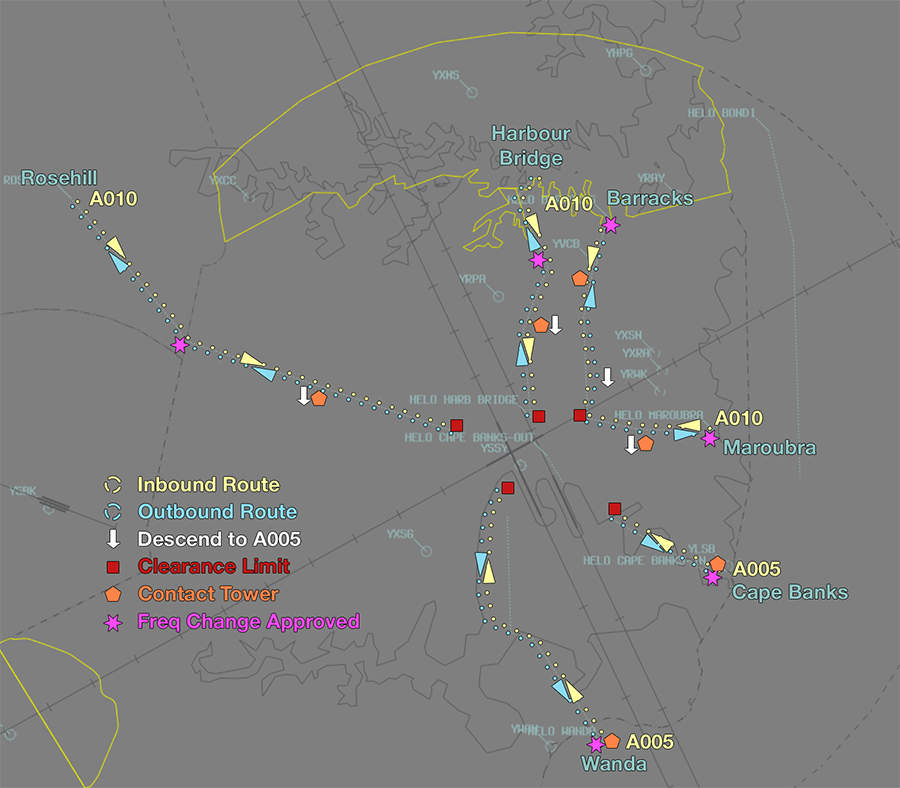
The routes are identified by geographical designators and a direction which must be used in all radio communication. Pilots cleared via a coded clearance must comply with all altitudes, clearance limits, and frequency transfer points specified in the route. ATC may amend the altitudes as required.
Details of each coded clearance are available in the YSSY ERSA FAC. Pilots must study this document to review the lateral and vertical requirements of each coded clearance.
YSSY Heliport
The heliport at YSSY (excluding H1) is outside the manoeuvring area. No takeoff or landing clearances will be issued, instead pilots will be instructed to "report airborne/on the ground". Pilots operating to/from H1 require an explicit takeoff or landing clearance.
When RWY 07 or 25 is in use, the heliport is managed by ADC West - 120.5. During all other runway modes, ADC East - 124.7 (if online) manages the heliport.
Inbound Procedures
Arriving helicopters shall contact ATC approximately 5 minutes before the prescribed entry gate and advise intentions.
TCU Routes
For the following designated routes, pilots must contact SYC, or the most appropriate terminal controller if SYC is not online.
| Route | Direction |
|---|---|
| BONDI 5 | SOUTH or NORTHBOUND |
| ROSEHILL 5 | INBOUND |
| HARBOUR BRIDGE 5 | INBOUND |
| BARRACKS 5 | INBOUND |
| MAROUBRA 5 | INBOUND |
Phraseology
XWY: "Sydney Departures, helicopter XWY, Long Reef, A010, received Delta, request Harbour Bridge 5 Inbound"
SY TCU: "XWY, squawk 0552, remain outside controlled airspace"
XWY: "Squawk 0552, remain outside controlled airspace, XWY"
SY TCU: "XWY, identified, cleared Harbour Bridge 5 Inbound"
XWY: "Cleared Harbour Bridge 5 Inbound, XWY"
Note
Where a frequency transfer point is specified, pilots must perform the nominated transfer without prompting from ATC, unless advised otherwise.
ADC Routes
For the following routes, pilots must contact SY ADC directly.
| Route | Direction | Frequency |
|---|---|---|
| CAPE BANKS 5 | INBOUND | ADC East - 124.7 (if online), Otherwise ADC West - 120.5 |
| WANDA 5 | INBOUND | ADC West - 120.5 |
For helicopters tracking via CAPS or MRBR, pilots should anticipate processing via a different inbound route due to YSSY runway configuration and traffic or sequencing requirements.
Outbound Procedures
Helicopters departing YSSY shall contact SY ACD for airways clearance for all designated routes.
Important
Receipt of a clearance does not constitute a takeoff clearance.
Phraseology
YOE: "Sydney Delivery, helicopter YOE, for the Harbour Bridge 5 outbound, request clearance"
SY ACD: "YOE, Delivery, cleared Harbour Bridge 5 outbound, squawk 0215, departure frequency 123.0"
YOE: "Cleared Harbour Bridge 5 outbound, squawk 0215, departure frequency 123.0, YOE"
Pilots may choose to depart from their company parking helipad or transit to H1 or H2, depending on the departure path and meteorological conditions. Approval must be sought to transit to these helipads.
Phraseology
YOE: "Sydney Tower, helicopter YOE, Hotel 7, request reposition Hotel 1"
SY ADC: "YOE, reposition approved"
YOE: "Reposition approved, YOE"
When ready for takeoff, contact the relevant ADC position.
Phraseology
HWD: "Sydney Tower, helicopter HWD, Hotel 7, for the Harbour Bridge 5 outbound, ready"
SY ADC: "HWD, Sydney Tower, report airborne"
HWD: "HWD"
HWD: "HWD, airborne"
SY ADC: "HWD, contact departures"
HWD: "Departures, HWD"
Note
Where a frequency transfer point is specified, pilots must perform the nominated transfer without prompting from ATS, unless advised otherwise.
VFR Scenic Flights
Harbour Scenic Flights
Coded clearances exist to allow pilots to conduct scenic flights in the Class C airspace over Sydney Harbour. Clearances are available subject to YSSY traffic and controller workload.
Expanded details and diagrams are available in the YSSY ERSA FAC and Sydney General Flying Guide (produced by Airservices Australia).
Tip
Pilots should submit a flightplan advising of their intention to conduct a Harbour Scenic, to minimise delays.
Important
VFR aircraft are not separated from other VFR aircraft in Class C airspace. Pilots must maintain their own separation with other aircraft operating in the vicinity. ATC will provide basic traffic information on these aircraft.
Airways Clearance Requests
Track via Class G airspace to LRF. Obtain the YSSY ATIS, then contact Sydney Centre on 124.55 (or the most appropriate frequency if they are offline) prior to reaching LRF and request a 'Harbour Scenic'.
Pilots must remain in Class G airspace until in receipt of a clearance.
Harbour Scenic Coded Clearance
Maintain A015.
Track LRF direct to HBB. Remain east of HBB and commence a left turn, remaining north of the Opera House.
Conduct 2 left orbits, remaining east of HBB, north of the Opera House, and west of Garden Island.
On completion of the second orbit, track via North Head to Manly Beach. Report passing Manly northbound.
Descent into Victor One
Pilots may request descent into Victor One South approaching Manly Beach. Subject to traffic, and when established east of the coast, you may be cleared to leave CTA on descent. Report to ATC leaving A015 then broadcast your position and intentions on the advisory frequency.
Important
In aircraft with a single radio you will need approval to leave the ATC frequency to make this broadcast.
You must reach A005 before passing South Head southbound. Report to ATC when established at A005 in Victor One South.
Victor One
A designated lane of entry exists along the coastline between JIBN and LRF, allowing aircraft to transit below the Class C steps. The route comprises Victor One NORTH and Victor One SOUTH which are differentiated by the lower limits of the overlying Class C airspace and by their tracking requirements.
Victor One is depicted on the Sydney VTC and Sydney General Flying Guide, with details published in the YSSY ERSA FAC. It may be flown in either direction.
Pilots should broadcast joining the Coastal Route, stating position and intentions. Pilots of opposite direction aircraft should respond with position and intentions.
Victor One South
Victor 1 South extends east of the coast between SYHD and JIBN and includes three coastal HLS at Wanda Beach, Cape Baily and Cape Banks. Pilots are required to maintain an altitude of exactly A005 on Sydney Local QNH.
To avoid entering the SY CTR, pilots must not coastal fly between Ben Buckler (the Northern headland of Bondi Beach) and Long Bay Headland.
Victor One North
Victor 1 North extends east of the coast between SYHD and LRF and has a maximum altitude of A010 on Sydney Local QNH. All operations in Victor 1 North must be conducted between A005 and A010. Operations below A010 must remain over water at all times.
Aircraft tracking southbound must ensure that they reach A005 before passing SYHD and entering Victor One South.
R407 (Sydney Harbour)
R407 is a block of restricted airspace established for use by seaplanes and helicopters with MTOW not above 2,500kg or that adhere to specific noise standards. No clearance is required to enter the airspace.
R407A extends south of the Parramatta River in the offshoot bordered by Millers Point, Pyrmont, and Balmain, from SFC to A005. R407B extends from RYB to SYHD bordered by the southern bank of the Parramatta River and the 8.5DME arc to the north, from SFC to A010.
Important
Aircraft must not climb above A005 in R407A or A010 in R407B without an airways clearance from SY TCU.
Seaplanes operate at low levels in R407B. Aircraft may be operating in the Class C airspace immediately above R407.
Aircraft are to broadcast intentions entering and leaving R407 on the advisory frequency.
Transit from Victor One to R407B is only available through Sydney Heads. Transit over land is not permitted.
Helicopter Transit and Access Lanes
Transit and access lanes exist to allow the transit of aircraft into/out of R407. The altitude specified for each lane must be maintained during lane transit.
Pilots shall keep to the right when flying along a helicopter lane. All helicopter routes shall be flown on Sydney local QNH.
Details of each lane (and some diagrams) are available in YSSY ERSA FAC. The table below gives an outline of the lane routing.
| Access Lane | Routing | Altitudes |
|---|---|---|
| Harbour Lane | Follow Parramatta River from Silverwater to Ryde Road Bridge, Gladesville Bridge, the Southern Pylon of Sydney Harbour Bridge, abeam Bradley's Head, abeam Middle Head, Sydney Heads and thence coastal to Long Reef. The lane is over water. | Not below A007 on QNH from Silverwater to Ryde Road Bridge; A005 on QNH between Ryde Road Bridge and the Harbour Bridge; A010 on QNH between the Harbour Bridge and Middle Head, climb and descent to be conducted East of the Harbour Bridge. Not above A010 on QNH, over water, between abeam Middle Head and Long Reef. |
| Lane Cover River Lane | Access Lane from Gladesville Bridge to Pennant Hills via Northern Suburbs Cemetary, follows the Lane Cove River Valley to Pennant Hills. | A005 on QNH between Gladesville Bridge and Delhi Rd; A007 on QNH between Delhi Rd and Pennant Hills. |
| North Shore Lane | Access Lane for the HLS near the Royal North Shore Hospital is shown on the diagram in YSSY ERSA FAC. |
A010 on QNH. |
Helicopter Coded Clearances
BONDI 5
The BONDI 5 coded clearance allows helicopters to transit the SY CTR and coastal fly between Ben Buckler (northern headland of Bondi Beach) and Long Bay Headland. Details of the route are available in YSSY ERSA FAC.
Delays may occur when RWY 07 is in use for departure or when RWY 25 is in use for arrivals. The route is not available in either direction when ILS PRM approaches are in use in the RWY 16 direction.
Note
The route operates in close proximity to Victor One. Helicopters should maintain a listening watch on the advisory frequency to ascertain any relevant conflicting traffic operating in the vicinity.
Helicopters will be identified and then cleared for the BONDI 5 NORTHBOUND or SOUTHBOUND. Traffic information will be provided on any other helicopters operating on the route or for any other aircraft in the area (e.g. aircraft in Victor One).
Phraseology
XVZ: "Sydney Approach, helicopter XVZ, Jibbon Point, A005, received Whiskey, request BONDI 5 Northbound"
SY TCU: "XVZ, Sydney Approach, squawk 0451, remain outside controlled airspace"
XVZ: "Squawk 0451, remain outside controlled airspace, XVZ"
SY TCU: "XVZ, identified, cleared BONDI 5 Northbound, QNH 1024"
XVZ: "Cleared BONDI 5 Northbound, QNH 1024, XVZ"
Helicopters must maintain A005 when operating south of Ben Buckler. North of Ben Buckler, helicopters must maintain not above A010.
Once you leave CTA (Long Bay Headland southbound, SYHD northbound), ATC will cancel your control and identification services.
Phraseology
SY TCU: "XVZ, leaving controlled airspace. Identification and control services terminated, squawk 1200, frequency change approved."
Terminal Airspace Sectors
To reduce frequency congestion, several commonly used geographically defined areas are designated with lateral and vertical limits and provided upon request via a coded clearance to a helicopter.
| Sector Name | Lateral Limits | Vertical Limits |
|---|---|---|
| City East | Bounded by Rushcutters Bay, Sydney Cricket Ground, Sydney Harbour Bridge South Pylon, Fort Denison, Clark Island, Rushcutters Bay | Not above A020 |
| CBD | Bounded by Rushcutters Bay, Sydney Cricket Ground, Cleveland Street, Regent Street, George Street, Sydney Harbour Bridge South Pylon, Fort Denison, Clark Island, Rushcutters Bay | Not above A020 |
| North Harbour | The area northeast of a line Roseville Bridge, Sydney Harbour Bridge North Pylon then via the northern shore of Sydney Harbour to Middle Head, then Manly | Not above A015 |
| Northern Beaches | The area east of a line Spit Bridge, Sydney Harbour Bridge North Pylon then via the northern shores of Sydney Harbour to Middle Head then Manly | Not above A015 |
| South Harbour | The area bounded by lines joining Sydney Harbour Bridge North Pylon, Sydney Harbour Bridge South Pylon, then via the southern shoreline of Sydney Harbour to South Head then Manly to Middle Head, then via the northern shoreline of Sydney Harbour to Sydney Harbour Bridge North Pylon | Not above A015 |
Helicopters intending to operate in one of the sectors must request clearance from the most appropriate TCU controller.
Phraseology
X3V: "Departures, helicopter X3V, passing A008 on the Harbour Bridge 5 Outbound, request South Harbour Sector."
SY DEP: "X3V, Departures, identified, onwards clearance South Harbour Sector."
X3V: "Onwards clearance South Harbour Sector, X3V."